Claude Managed Agents launched on April 8, 2026, and it solves the hardest part of building AI agents: everything that isn't the model itself. Sandboxing, state management, credential handling, crash recovery, context engineering — the managed platform handles all of it. Internal benchmarks show a 60% reduction in p50 time-to-first-token and up to 10-point improvements in task success rates compared to self-hosted agent loops.
If you've spent weeks building agent infrastructure — wiring up container orchestration, implementing retry logic, managing session state — this is the platform that makes most of that code unnecessary.
Here's what the architecture looks like, when it makes sense to adopt, and where the boundaries are.
How Claude Managed Agents Decouples Session, Harness, and Sandbox
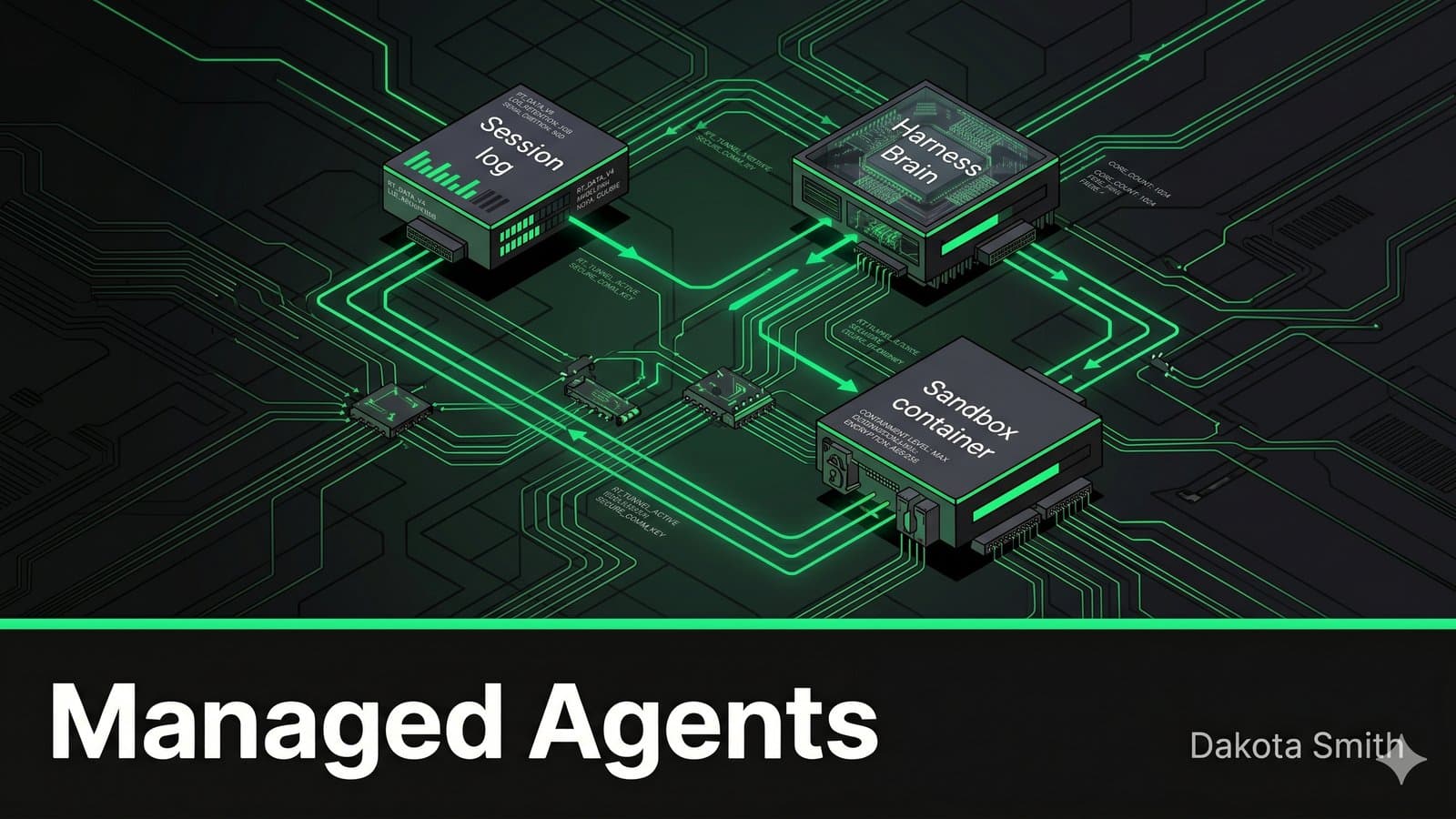
The core design decision behind Managed Agents is a three-way separation of concerns that treats each component as independently swappable:
| Component | Responsibility | Key Property |
|---|---|---|
| Session | Append-only event log storing all interactions | Lives outside the harness — survives crashes |
| Harness | Orchestration loop that calls Claude and routes tool outputs | Stateless — scales horizontally |
| Sandbox | Container for code execution and file operations | Interchangeable — one brain, many hands |
This decoupling exists because Anthropic's earlier architecture coupled the harness directly inside containers. When containers failed, entire sessions were lost. The new design treats the harness as stateless. It calls sandboxes via a standard execute(name, input) → string interface. If a container dies, a new one initializes via provision({resources}) without losing session history.
The performance gains are significant. By decoupling containers from harnesses, sessions no longer wait for container provisioning before inference begins. The p95 time-to-first-token dropped by more than 90%.
Session Durability in Practice
Because session logs live outside the harness, crash recovery becomes straightforward:
// Harness recovery after failure
const session = await getSession(sessionId);  // Retrieve full history
const harness = await wake(sessionId);        // Reboot harness
await emitEvent(sessionId, resumeEvent);      // Resume from last event
No complex recovery protocols. No lost context. The session is the source of truth, and harnesses are disposable workers that read from it.
Security Boundaries
Credentials never exist inside sandboxes where untrusted code executes. Managed Agents enforces this through two authentication patterns:
- Resource-bundled auth: Git tokens initialize repos during provisioning, then wire into local remotes — the token never appears in the execution environment
- Vault-stored credentials: OAuth tokens stored externally; a proxy fetches them for outbound service calls
This matters because agent sandboxes run arbitrary code. Any credential placed inside a sandbox is a credential that user-generated code can exfiltrate.
What You Get Out of the Box
Managed Agents provides a complete agent runtime with built-in tools:
- Bash: Run shell commands in the container
- File operations: Read, write, edit, glob, and grep files
- Web search and fetch: Search the web and retrieve URL content
- MCP servers: Connect to external tool providers
- Prompt caching and compaction: Built-in context management optimizations
The API surface centers on four concepts — Agent (model + system prompt + tools), Environment (container template with packages and network rules), Session (a running agent instance), and Events (messages exchanged via server-sent events).
Here's the minimal flow to get a session running:
import Anthropic from "@anthropic-ai/sdk";

const client = new Anthropic();

// 1. Create an agent
const agent = await client.beta.agents.create({
  model: "claude-sonnet-4-6-20260414",
  system: "You are a code review assistant.",
  tools: [{ type: "bash" }, { type: "file_editor" }],
});

// 2. Create an environment
const env = await client.beta.environments.create({
  packages: ["python3", "nodejs"],
  network_access: { allowed_domains: ["github.com"] },
});

// 3. Start a session and stream events
const session = await client.beta.sessions.create({
  agent_id: agent.id,
  environment_id: env.id,
});

await client.beta.sessions.events.create(session.id, {
  type: "user",
  content: "Review the PR at github.com/org/repo/pull/42",
});
The SDK sets the required managed-agents-2026-04-01 beta header automatically. Rate limits apply: 60 create requests/minute and 600 read requests/minute per organization.
Messages API vs. Managed Agents: When to Use Which
This isn't a replacement for the Messages API. It's a higher-level abstraction for a specific class of workloads.
| Factor | Messages API | Managed Agents |
|---|---|---|
| Control | Full control over agent loop, tool execution, retries | Anthropic manages the loop |
| Infrastructure | You build and maintain sandboxes, state, auth | Managed containers, persistent sessions |
| Latency | Direct API calls, minimal overhead | Container provisioning adds startup time |
| Session duration | Stateless (you manage context) | Hours-long stateful sessions with persistence |
| Tool execution | You implement tool handlers | Built-in bash, file ops, web, MCP |
| Cost structure | Pay per token | Pay per token + compute time |
Use Messages API when:
- You need sub-second response times for synchronous interactions
- Your agent loop has custom logic that doesn't fit the managed model
- You need fine-grained control over every tool call and retry
Use Managed Agents when:
- Tasks run for minutes or hours with dozens of tool calls
- You need secure code execution without building your own sandbox
- You want session persistence across disconnections
- You'd rather configure than build infrastructure
Who's Building With It
Several companies are already in production or late-stage integration:
- Notion: Agents handle parallel tasks — coding, content creation — with team collaboration features layered on top
- Rakuten: Enterprise agents deployed across product, sales, marketing, and finance departments, integrated with Slack and Teams for task delegation
- Asana: "AI Teammates" work alongside humans, picking up tasks and drafting deliverables within existing project workflows
- Sentry: A debugging agent pairs with a patch-writing agent, automating the bug-report-to-pull-request pipeline
- Vibecode: Uses managed sessions for rapid app deployment, reporting 10x faster infrastructure spin-up
The pattern across these deployments: teams that were spending months building agent infrastructure — sandboxing, credential management, crash recovery — redirected that effort to product features. If you've followed my work building autonomous coding agents with STUDIO, the appeal is obvious: Claude Managed Agents provides the infrastructure layer that every agent builder ends up reinventing.
The Multi-Brain, Multi-Hands Model
The decoupled architecture enables a scaling model worth understanding. Because harnesses are stateless and sandboxes are interchangeable, you can scale both axes independently:
Multiple brains: Spin up stateless harnesses horizontally. Each connects to sandboxes only when needed, then releases them.
Multiple hands: Each sandbox becomes an interchangeable tool. A single harness can reason about multiple execution environments and route work accordingly — containers, custom tools, MCP servers, or any system behind the execute() interface.
Multi-agent coordination (multiple harnesses collaborating on a task) is available as a research preview. So is persistent memory across sessions and outcome-based evaluation. These features require a separate access request.
Tradeoffs and Limitations
Managed Agents trades flexibility for operational convenience. Here's what you give up:
Less control over the agent loop. You can steer mid-execution and interrupt, but you can't customize the core orchestration logic. If your agent needs non-standard retry strategies, custom tool routing, or model-switching mid-conversation, the Messages API gives you that control.
Beta stability risks. The managed-agents-2026-04-01 beta header signals that APIs and behaviors may change between releases. Production workloads need to account for breaking changes.
Container startup overhead. While the decoupled architecture eliminated most provisioning delays (the 60% p50 improvement), the first interaction in a session still involves container initialization. For latency-sensitive, single-turn interactions, the Messages API is faster.
Vendor lock-in. Your agent logic lives inside Anthropic's infrastructure. Migrating to self-hosted or another provider means rebuilding the harness, sandbox management, and session persistence you didn't have to build initially.
Research preview features are gated. Multi-agent coordination, memory, and outcomes — three of the most compelling capabilities — require separate access approval and carry additional stability caveats.
When NOT to use Managed Agents:
- Single-turn Q&A or chatbot interfaces (overkill for the use case)
- Latency-critical applications under 500ms response time requirements
- Workloads requiring custom model routing or non-Claude models
- Environments where data residency prevents cloud-hosted execution
Conclusion
Claude Managed Agents represents a clear shift: Anthropic is moving up the stack from model provider to agent platform. The decoupled session-harness-sandbox architecture solves real infrastructure problems that every team building agents has encountered.
Key Takeaways:
- The three-way decoupling (session, harness, sandbox) is the key architectural insight — it enables crash recovery, horizontal scaling, and secure credential isolation in a single design
- Performance gains are concrete: 60% p50 and 90%+ p95 time-to-first-token reductions from eliminating container-inference coupling
- The Messages API remains the right choice for low-latency, high-control use cases — Managed Agents targets long-running, infrastructure-heavy workloads
- Multi-agent coordination, memory, and outcomes are in research preview — compelling features that aren't production-ready yet
- Five major companies (Notion, Rakuten, Asana, Sentry, Vibecode) are already building on the platform, validating the "managed over DIY" approach
The decision framework is straightforward: if you're spending more engineering time on agent infrastructure than on agent behavior, Managed Agents eliminates that overhead. If you need full control over every inference call, stick with the Messages API and build the infrastructure yourself.
You Might Also Like
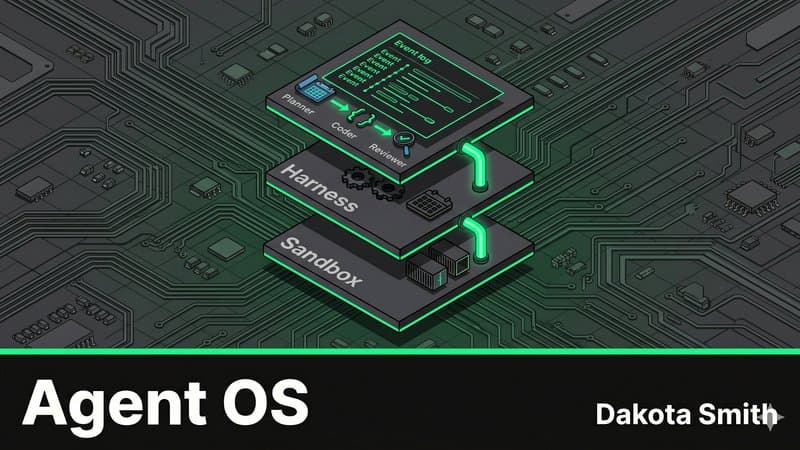
The Agent Operating System: Multi-Agent Pipelines with Claude
Map OS abstractions to Claude Managed Agents architecture and build a three-agent auto-PR pipeline that plans, codes, and reviews autonomously.
WebMCP: How Chrome Turns Websites Into AI Agent APIs
Explore Chrome's WebMCP protocol that lets websites expose structured tools to AI agents, replacing brittle scraping with stable, typed APIs.
Building Plugin GTM: A Go-To-Market Engine Inside Claude Code
Learn how I built a 29-tool MCP server that handles product analysis, GTM strategy, content generation, and launch tracking without leaving the terminal.
Comments
Loading comments...